
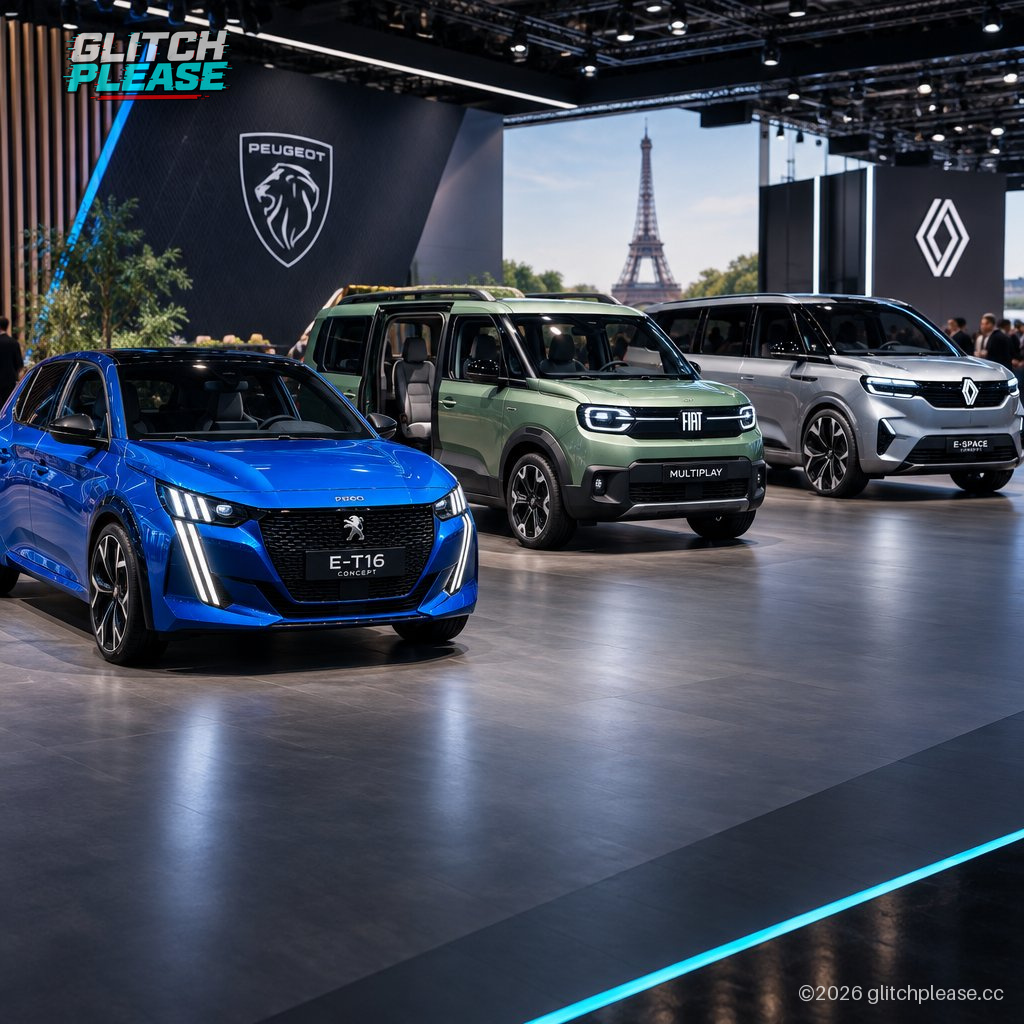
The Paris Auto Show is making a quietly persuasive case for cars Americans rarely get: small, interesting hatchbacks and people carriers designed around actual passengers instead of the assumption that every errand requires an SUV the size of a modest outbuilding.
Peugeot’s E-T16 Concept reaches back to the 205 GTi and the wilder 205 T16 Group B rally homologation special. The original 205 GTi was a European answer to the sort of late-1980s Volkswagen Golf GTI familiar to American drivers; the rally-bred T16 won the World Rally Championship in 1985 and 1986. The new concept carries that performance-hatchback lineage forward. As the Renault 5 Turbo 3e did last year, it suggests that a small hatchback can be more than a sensible box for groceries and errands. The multifunction steering wheel, at least, deserves a few questions before anyone declares victory for futuristic interfaces.
Not everyone needs a tiny car. Families need room, and Europeans know this too. Fiat and Renault brought concepts aimed at the space between “too small” and “why does this vehicle need its own zip code?”
Fiat’s Multiplay nods to the late-1990s Multipla, whose unconventional shape concealed a clever arrangement: six seats in two rows of three. Rather than simply recreating that layout around a battery pack, the Multiplay explores a more adaptable format, shifting from a three-row people carrier to a pickup. Its front passenger seat can become a lounger, while a modular “Petsenger” mounting point can take a pet bed, child car seat, storage compartment, or small table. That is concept-car ambition, naturally, but the underlying idea is refreshingly practical: configure the cabin for what you’re carrying, not just what looks tidy in a brochure.
Renault’s E-Space Concept revisits the original Espace, the people carrier that helped create the segment in Europe. The familiar one-box shape remains, though enormous 23-inch wheels give this version a toy-car quality the 1984 model could have done without. Apparently, even concept designers struggle to resist making wheels bigger than the useful parts around them.
These are concepts, not confirmed showroom choices for American buyers. That distinction matters: a clever cabin or nostalgic nameplate is not a promise of production, much less a US launch. Still, the gap is conspicuous. The source notes that the Volkswagen ID. Buzz is the only electric minivan available in the United States—and that weak sales led Volkswagen to suspend imports for a model year. That makes a production E-Space coming here look unlikely, though the concept itself is no guarantee of a European launch either.
The point isn’t that every American needs a tiny EV or a modular family van. It’s that car design can prioritize space efficiency, flexibility, and a little personality without defaulting to another giant SUV. Paris is showing the ideas. Whether automakers think American buyers deserve the choice is another question.
Sources: Glitch Please! and Ars Technica — https://arstechnica.com/cars/2026/10/europe-shows-a-better-alternative-to-big-suvs-at-the-paris-auto-show/ — Source article and reporting
Generated by AI
