
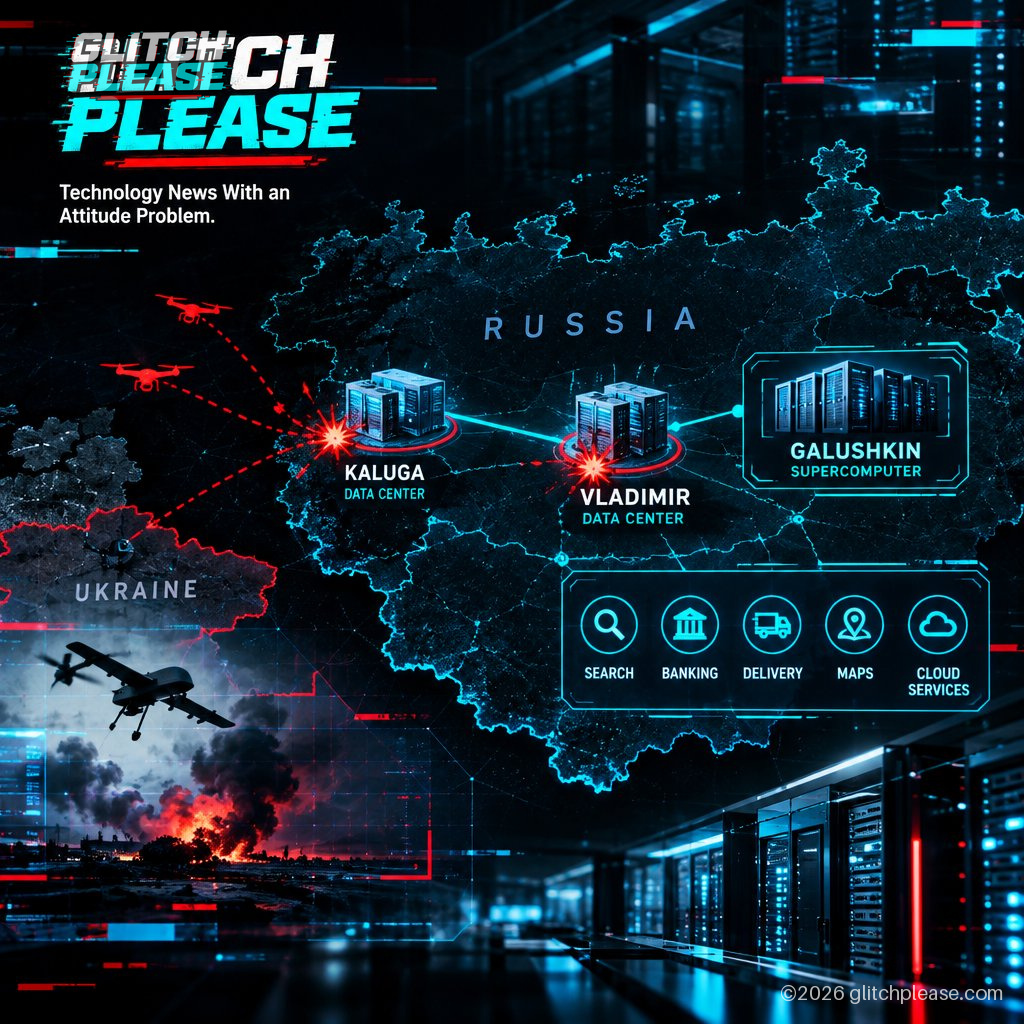
Ukrainian drone strikes have disrupted Yandex data centers in Russia, exposing a wartime weakness in a digital economy built around a handful of powerful infrastructure hubs. The damage has reportedly affected everything from payment and banking apps to maps, email and food delivery. Russia’s digital convenience machine turns out to have a fairly inconvenient failure mode: concentration.
A Ukrainian strike on October 9 knocked out another Yandex data center in the Kaluga region, southwest of Moscow. The facility is among Russia’s largest, with a maximum capacity of 63 megawatts. On October 11, a third strike forced Yandex to suspend operations at its data center in Vladimir, east of Moscow, according to BBC News.
The Vladimir facility houses Galushkin, the third of Yandex’s three supercomputers. It ranked 134th on the Top 500 list, with a rated performance of 20.64 petaflops. That is an impressive amount of computing power to have sitting inside infrastructure that can be knocked offline. The more immediate public impact, however, is less about supercomputer rankings than whether digital services work when people need them.
Reported interruptions or outages have hit popular Russian payment apps and digital banking services, as well as email, e-commerce, video streaming, ride-hailing, food delivery and navigation. Yandex’s search engine accounts for about 70 percent of the Russian market, according to the source report. Damage has also affected Yandex’s cloud computing service, which The Moscow Times says is used by some of Russia’s largest companies, including grocery and fast-food chains and a household appliance retailer.
This is the trade-off in building an enormous digital ecosystem around a dominant provider: integrated services can be convenient and efficient, but trouble at a small number of major nodes can ripple across sectors. Russian milblogger Ratio Militaris warned that Yandex’s hyper-centralized ecosystem had become a wartime weakness, despite once being viewed as an advantage over even Western countries. The concern, in a post translated by ChrisO_wiki, was not simply market dominance. It was the concentration of infrastructure in a few large data centers.
Russia’s ability to create backup capacity outside the country may also be limited. Another milblogger, Artjockey, pointed to the 2019 “Sovereign Internet Law,” passed by Russia’s parliament and signed by President Vladimir Putin, as a constraint on building overseas infrastructure for added resilience. The law’s name promises sovereignty; the practical question raised by these strikes is whether a tightly controlled digital system can stay resilient when its core facilities are hit.
None of this means every Russian online service has failed, or that the full scale and duration of the reported disruptions are clear. But the strikes have made a vulnerability visible: centralization can simplify a digital economy right up until its central infrastructure becomes a target. Russia’s services were built to work together. Now they have to prove they can keep working when the system’s biggest pieces cannot.
Sources: Glitch Please! and Ars Technica — https://arstechnica.com/gadgets/2026/10/russia-was-not-ready-for-the-data-center-war-it-started-with-ukraine/ — Source article, BBC News (as cited in the source article), The Moscow Times (as cited in the source article), ChrisO_wiki translations of posts by Ratio Militaris and Artjockey
Generated by AI
