
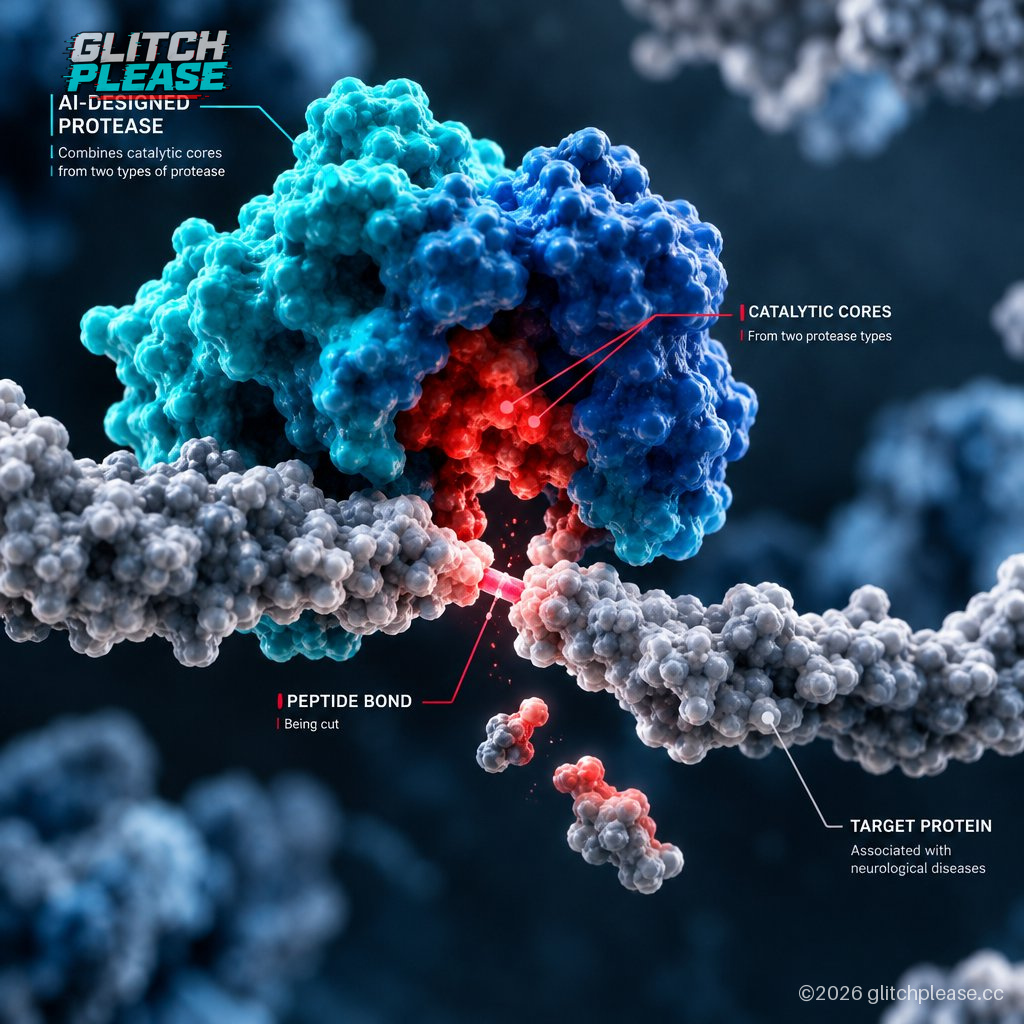
Researchers have used AI-based protein-design tools to create enzymes that cut selected proteins apart, including proteins associated with neurological diseases. The work takes a shortcut through a process nature spent a very long time refining: the researchers kept the catalytic core of two types of protease and replaced the rest of each protein.
That matters because the bonds holding proteins together are remarkably stubborn. Peptide bonds—the links between amino acids—are estimated to have a half-life of several hundred years in water. Left alone, they are in no hurry to come apart. Life solves this with proteases, enzymes that catalyze the reaction and help organisms break down proteins. There are many kinds, each adapted to particular targets and jobs. Biology, in other words, built a large specialist workforce. The researchers tried redesigning the hiring process.
The team used the catalytic machinery from two protease types as a starting point, then used AI design tools to replace the rest of the protein. The resulting enzymes could be tuned to cut specific proteins. One of the mechanisms described in the research uses zinc: the metal ion helps position the peptide bond and other components, while activating a water molecule to attack the bond. That chemical assistance is what turns an otherwise glacially slow reaction into something an enzyme can accomplish.
The researchers demonstrated the designed enzymes’ ability to cut proteins associated with neurological diseases. That is a demonstration of targeted protein cutting—not evidence that the enzymes treat, prevent, or cure those diseases. The distinction is worth keeping intact, particularly in a field where “worked on a disease-related protein” can quickly become “breakthrough therapy” after passing through a few marketing departments.
Still, the approach is significant. Instead of waiting for natural evolution to produce an enzyme with the desired combination of structure and activity, researchers used existing catalytic cores as functional starting points and redesigned the surrounding protein. The result suggests AI tools may help create enzymes with chosen targets, though the source material does not establish how broadly the method works, how precise the enzymes are across different conditions, or whether they can be used safely in living organisms.
Those questions matter. A protein-cutting enzyme needs to hit the intended target while avoiding proteins it has no business touching; showing activity in a research setting is only one step toward any practical application. But making bespoke molecular scissors from established catalytic parts is a meaningful advance. Peptide bonds may be built to outlast several generations of household appliances. Researchers are now finding ways to give them a more immediate appointment with chemistry.
Sources: Glitch Please! and Ars Technica — https://arstechnica.com/science/2026/10/researchers-use-ai-to-design-proteins-that-cut-up-other-proteins/ — Reporting and research details
Generated by AI
