
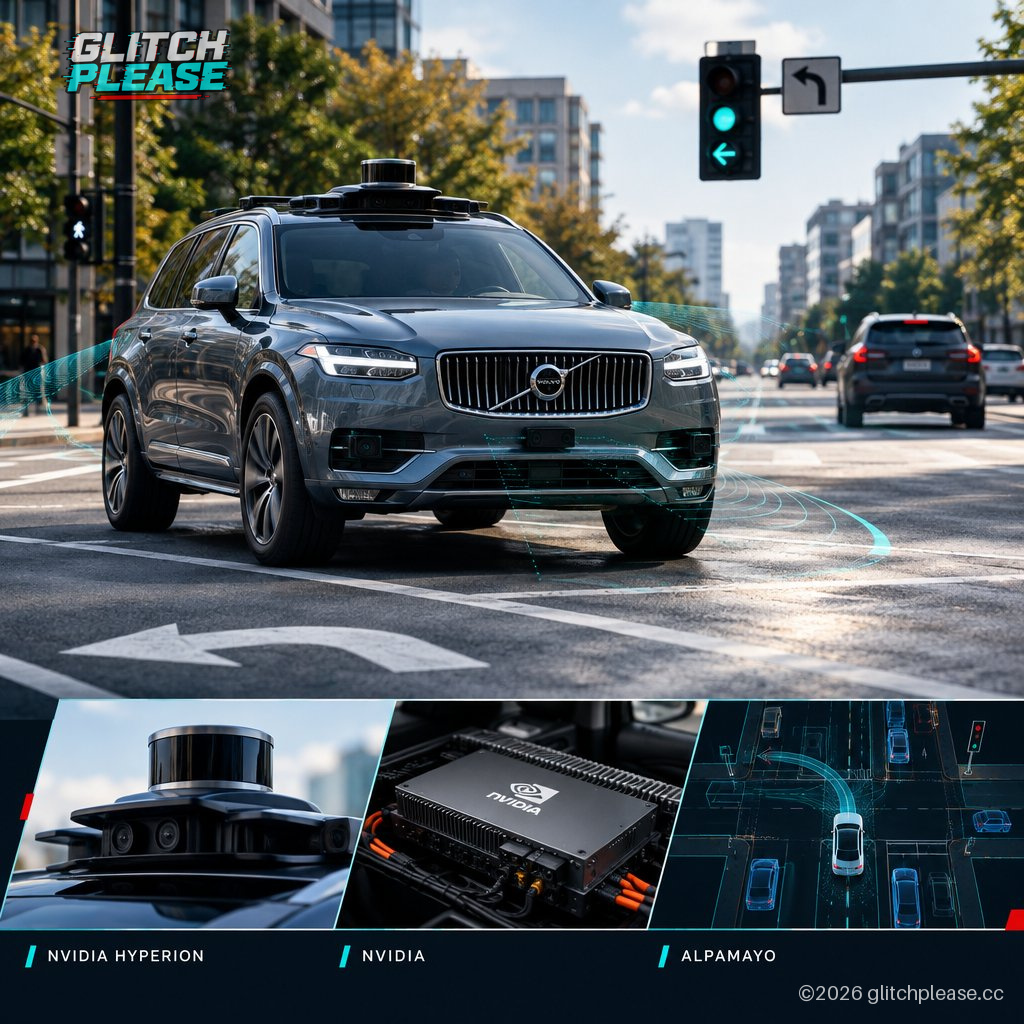
Volvo plans to bring hands-free, point-to-point driving to its cars before the end of the decade, using Nvidia technology to navigate roads that are considerably more complicated than a straight stretch of highway. The promised system would handle urban situations such as traffic lights, stop signs and unprotected left turns. It would also remain Level 2 driver assistance: hands-free does not mean the human in the car gets to mentally clock out.
The Chinese-owned, Swedish-designed automaker says the system will use Nvidia’s Hyperion platform, combining the chipmaker’s hardware with additional vehicle sensors. Nvidia’s Alpamayo software uses what the companies describe as “reasoning” models to interpret road conditions and decide when to steer, brake or accelerate.
Volvo is not planning to include lidar in the setup at launch, though the company could add the laser-based sensor later. That is a notable omission given the automaker’s earlier plans to include lidar in some models—a plan that fell away after supplier Luminar went bankrupt. In automotive technology, the sensor suite is only as dependable as the company supplying it. This is not the first time the industry has learned that the hard way.
The proposed system resembles Tesla’s Full Self-Driving (Supervised) and a Nvidia-powered system recently introduced by Mercedes-Benz for its new CLA sedan, Nvidia automotive chief Ali Kani told The Verge. The important word in Tesla’s product name—and in the broader Level 2 category—is “supervised.” The system may take on more of the driving, but this is not a promise that Volvo’s cars will drive themselves without a responsible human behind the wheel.
Volvo wants its own safety technology to be part of the equation. That includes driver-understanding systems that analyze a driver’s behavior in more detail than a basic driver-monitoring setup, according to Alwin Bakkenes, Volvo Cars’ head of global software engineering. The company also plans to use its connected-safety technology, which shares information about hazards and conditions such as roadworks between vehicles. That could help the car learn about trouble beyond what its own sensors can see.
There is some corporate history behind the cautious framing. Volvo previously had to sideline Ride Pilot, its Level 3 system intended to drive without constant driver supervision in the US, after it failed to obtain regulatory approval. Now the company is pursuing a less ambitious level of automation with Nvidia—and promises to bring it across its lineup, from entry-level cars to high-end models. Volvo has not said which vehicles will get it first.
The timeline is similarly broad: Volvo says the system will arrive “before the end of the decade,” with 2030 the stated horizon, rather than offering a specific launch date. Nvidia also sees a business opportunity in helping Volvo build ongoing software-based offerings around the feature. So the pitch is part safer driving, part new revenue stream—an increasingly familiar combination in cars that are becoming rolling software platforms.
Volvo’s ambition is clear. Whether the system earns trust will depend on how it behaves on real roads, what drivers are still expected to do, and whether the hardware and software arrive together as promised. After Ride Pilot and the lost lidar plan, “we’ll see” is not cynicism. It is quality control with a memory.
Sources: Glitch Please! and The Verge — https://www.theverge.com/transportation/1011653/volvo-nvidia-autonomous-driving-level-2-hands-free-urban — Reporting by Andrew J. Hawkins; interviews and details attributed to Volvo and Nvidia as reported by The Verge.
Generated by AI
