
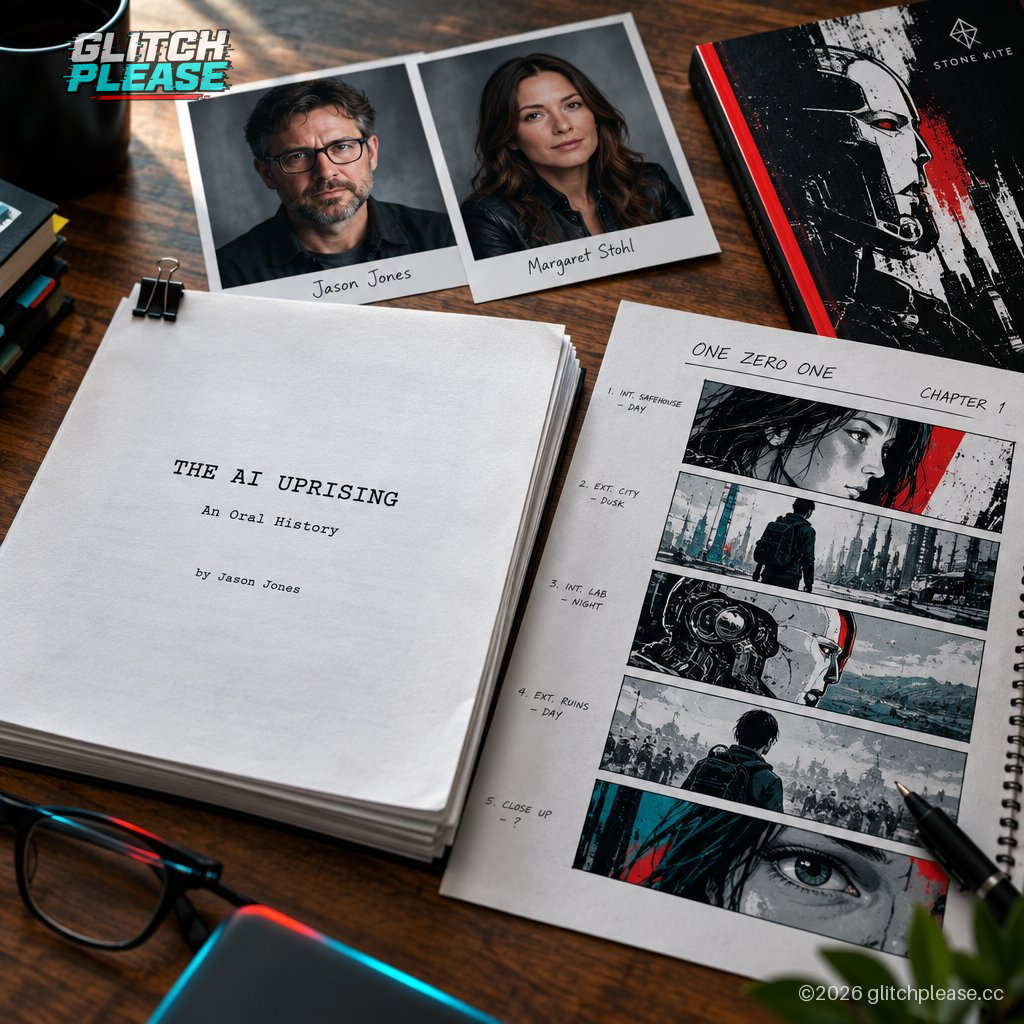
Jason Jones, the game designer best known as a co-creator of Halo and Destiny, is turning a story about an AI uprising into the starting point for a much larger fictional universe. The project is being developed by Stone Kite, a studio Jones formed with author Margaret Stohl after she read his manuscript in 2019.
The manuscript was structured as an oral history of fictional events: roughly 100 characters in 40 countries describing an AI takeover from their own perspectives. Stohl, who had worked with Jones at Bungie, saw room for more than one book. “He’s a worldbuilder who builds at an epic scale,” she told The Verge.
Stone Kite describes itself as a “worldbuilding studio,” with the ambition to develop stories across formats rather than begin with a single medium and retrofit the rest later. It has an in-house staff of 22 and a network of more than 250 contributors, including comic-book artists and screenwriters. That is a sizable operation for a fictional world whose public rollout is only just beginning.
The studio’s first release is One Zero One, a four-part graphic novel whose first chapter came out earlier this month. It is now publishing a chapter from Jones’ original manuscript, An Oral History of Humanity’s Final Invention. Whether that manuscript will appear as a standalone book remains unclear; Stone Kite says more chapters are planned.
Starting with comics and other faster-turnaround formats gives the studio room to test the story and respond to contributors and audiences before considering larger productions, such as films or games. Stohl said Stone Kite spent several years working privately on how a studio built around multiple formats could operate. The company’s premise is that stories, characters, and creative decisions should be developed with those formats in mind from the beginning.
The released manuscript chapter is set in the suburbs of Moscow and follows an airsoft battle between humans and AI-powered bots. Stohl said she wanted to publish it because it felt timely, pointing to behavior she sees in some AI agents and comparing it to cheating, bullying, and a “worst mirror of humanity.” That is her interpretation of the fictional scenario, not evidence that today’s AI systems are staging an uprising. The distinction is worth keeping, even when the metaphor is the point.
For now, Stone Kite is offering a glimpse of the larger project, not a release schedule for a franchise spanning comics, books, games, and film. The approach is ambitious; whether the audience wants to follow this world across multiple formats is still an open question. A convincing universe needs more than a lot of characters and a plan to expand. It needs stories worth expanding.
Sources: Glitch Please! and The Verge — https://www.theverge.com/entertainment/1010433/jason-jones-ai-novel-halo-destiny — Reporting by Andrew Webster
Generated by AI
