
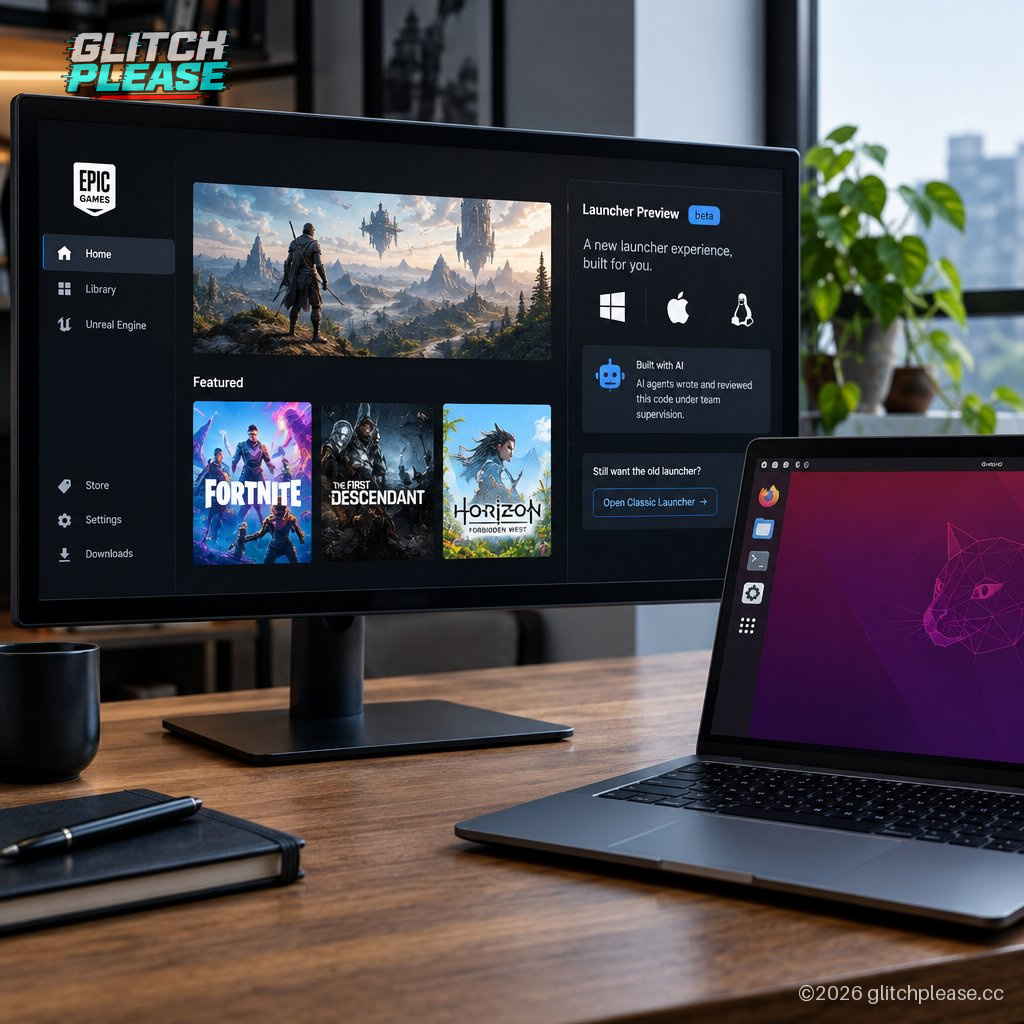
Epic Games is previewing a redesigned PC launcher it says is “way faster” and more responsive—and it is making no secret of how the software was built. The company describes the project as “vibe coded,” a breezy label for development that relied heavily on AI tools and agents.
The new launcher is available in preview on Windows, Mac, and Linux. Epic says the team has worked on it for most of this year, using AI to help test the software and reproduce the existing launcher’s core features. The company also plans to bring Fortnite to Linux through the app.
That is a meaningful platform expansion, even if “way faster” remains Epic’s claim rather than an independently established result. The old launcher will remain available while Epic works toward feature parity and considers the new version stable enough for a full launch. There is no specific date for that switch.
Martin Keely, Epic’s vice president and general manager of the Epic Games Store and Epic Online Services, told The Verge that AI agents wrote and reviewed all of the code. He also emphasized that the development team managed and supervised the work. That distinction matters: Epic is describing AI-assisted development, not a product built without engineers making decisions about what to build, how it should behave, and whether the output works.
Still, the launcher is arriving as Epic makes AI a company-wide priority. CEO Tim Sweeney said Monday that the company has a “huge pivot underway,” moving developers to “retool for maximum AI acceleration.” He said the goal was not to do the same work with fewer people, but to let teams build “MORE and BETTER stuff” and bring AI’s benefits to developers using Unreal Engine.
That stated ambition sits alongside a more sweeping report from Bloomberg: a director on an unannounced Disney game allegedly told staff, “No more hand-written code.” Keely said the launcher team did not follow that model, though he called its work part of the same broader direction. A launcher preview cannot settle what AI will mean for game development. It can, however, show how Epic wants its employees—and the rest of the industry—to think about the transition: as a productivity tool under human supervision.
There is another relevant piece of context. Epic laid off more than 1,000 staffers in March. Sweeney said in a memo at the time that the cuts were not related to AI, adding that if AI improved productivity, Epic wanted to have as many developers as possible building content and technology. Those statements do not establish that AI caused the layoffs; Sweeney explicitly denied that connection. They do leave the company’s workforce strategy in view as it promotes tools intended to accelerate development.
For players, the immediate test is practical: whether the refreshed launcher is faster, works reliably across three operating systems, and brings Linux users a route to Fortnite. For Epic, the test is broader. The company is presenting this project as evidence that AI-assisted workflows can deliver useful software. The code may be new; the claims still need to run in production.
Sources: Glitch Please! and The Verge — https://www.theverge.com/games/1010751/epic-games-launcher-vibe-coded-ai-linux — Reporting by Jay Peters; includes comments from Epic executive Martin Keely and statements by CEO Tim Sweeney.
Generated by AI
